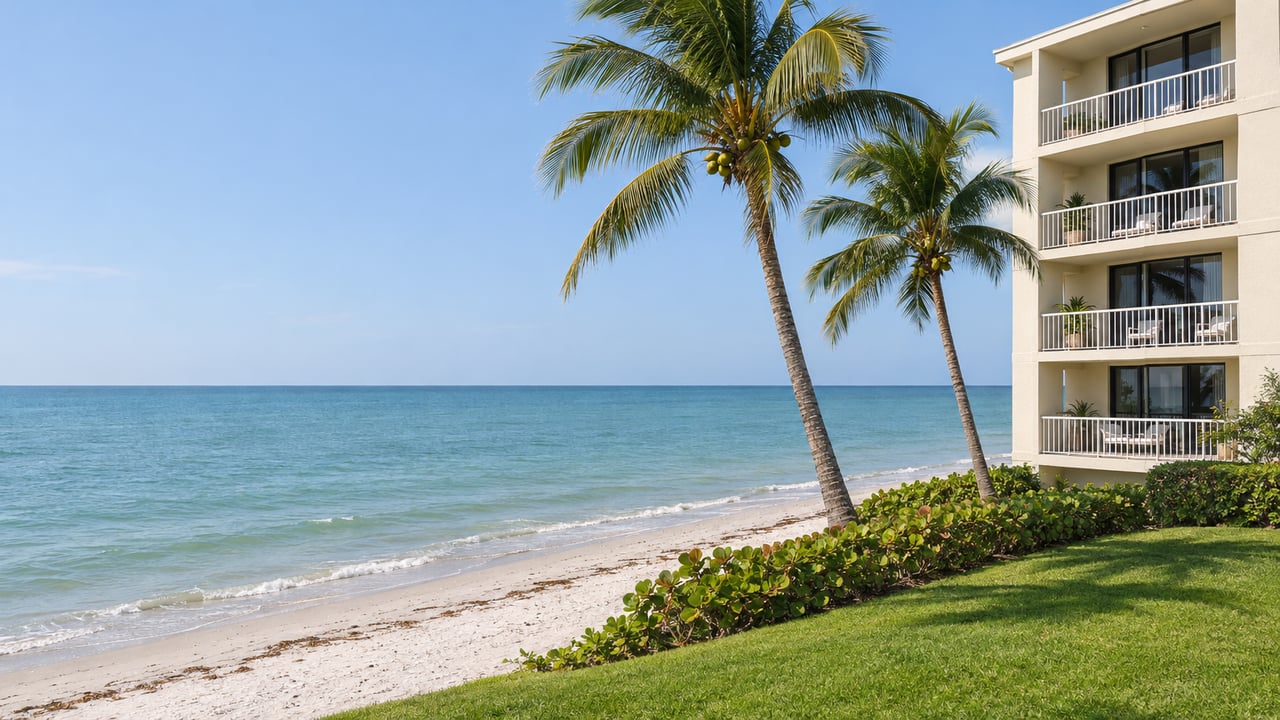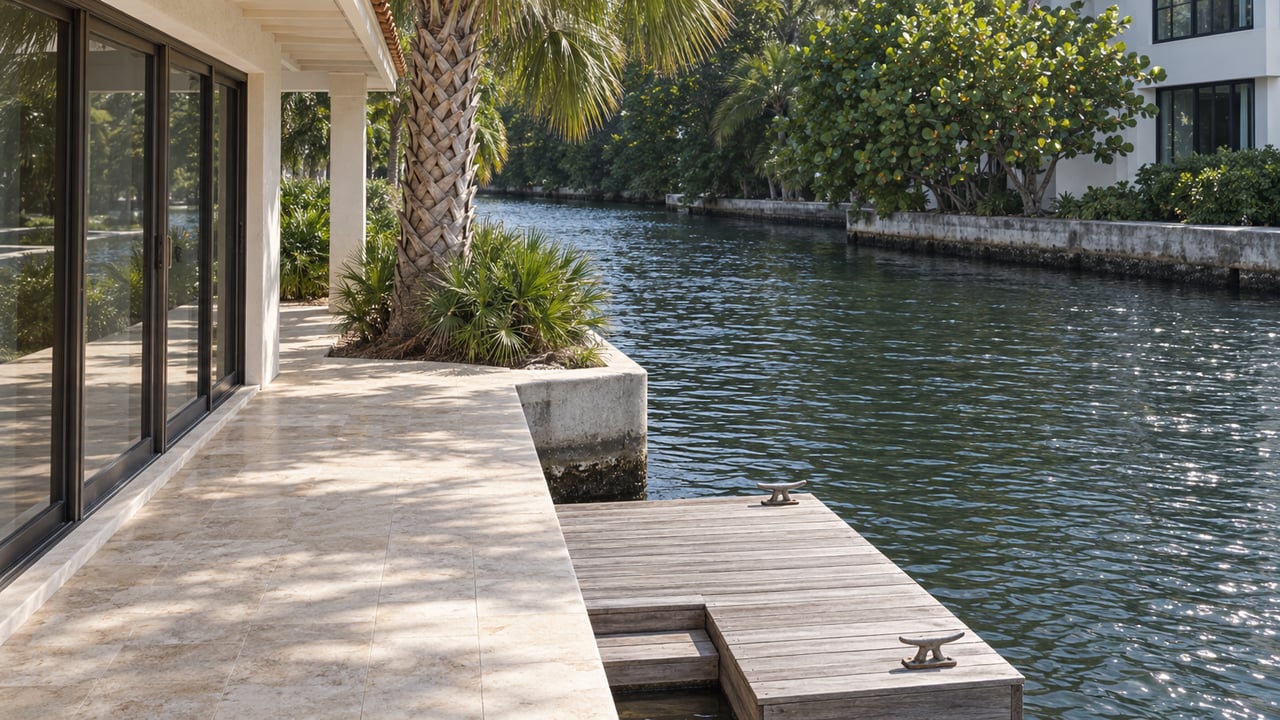
Royal Harbor markets itself on one line: bridge-free access to the Gulf of Mexico through Gordon Pass. It's the neighborhood's whole pitch, repeated on every listing sheet from Kingfish Road to the interior streets named for fish and birds. The claim is true for the neighborhood. It is not equally true for every dock in it.
A boat that clears Gordon Pass from a wide bayfront lot may not fit the canal three streets inland, even though both addresses carry the same "no bridge access" language and sit inside the same half-square-mile community on the eastern shore of Naples Bay. The neighborhood removed the bridge problem decades ago. It never equalized the canals.
The Feature Everyone's Selling, Priced Two Different Ways
No-bridge access is genuinely rare on this coast. Most of Naples Bay's residential waterways answer to at least one fixed span, which caps mast height and vessel clearance regardless of how deep the water runs underneath. Royal Harbor and Aqualane Shores are communities where that cap doesn't apply, and the market treats them differently for it. Aqualane Shores charges a real premium for guaranteed clearance on every lot. Royal Harbor built its reputation as the value alternative, offering the same bridge-free route to the Gulf at a lower entry price.
That value proposition holds up on average. It gets more complicated lot by lot, because "average" is doing a lot of the work.
The Canal Is the Real Unit of Value, Not the Zip Code
Royal Harbor's canals were cut at different widths and depths during the neighborhood's original 1950s through 1970s development, and that variation never went away even as the homes above the water were torn down and rebuilt. The wide, deep canals off Kingfish Road and the bayfront lots facing Naples Bay directly can handle yachts, large sport fishers, and sailboats with tall masts. The interior canals, cut narrower for a different era of smaller boats, are better suited to mid-size powerboats and center consoles. Transit time out to Gordon Pass is roughly the same from either position. What changes is whether your specific boat fits the water in front of your specific dock.
That distinction matters most for buyers with wide-beamed catamarans or larger motor yachts, where canal width becomes the binding constraint even when the bridge problem has already been solved for the whole neighborhood. Two listings both advertising bridge-free Gulf access can describe two very different ceilings on what actually gets to sail out of them.
Golden Shores and Oyster Bay, the two sub-areas that round out the broader Royal Harbor community, follow the same rule. The bridge-free claim covers all of it. The width and depth of the water in front of any one house doesn't.
What the Median Doesn't Separate
As of September 10, 2026, there were 27 active Royal Harbor listings, averaging $5.7 million in asking price and ranging from $1.2 million to $14 million, with an average of $1,705 per square foot across four-bedroom, four-bath homes near 3,259 square feet. Over the trailing 12 months through that same date, the median sale price ran $2,187,500, up 18 percent from the prior 12-month period. Homes there sold in a median of 157 days, well above a 49-day national comparison figure. A separate reading from February 2026 put the median sale price at $2,401,750, up 17.2 percent year over year, a reminder that the number moves depending on which window you're looking through.
None of those figures separate bayfront and Kingfish Road properties from interior-canal properties. They're one blended number describing a neighborhood where the underlying water access varies house to house. A buyer comparing a $3.9 million interior-canal home to a $9 million bayfront estate isn't just paying for square footage and finish level. Part of that spread is the water itself, and the median price alone won't tell you which part.
The extended time on market is worth sitting with too. A neighborhood where the headline feature is genuinely rare and appreciating shouldn't need 157 days to sell a typical listing. Some of that gap likely reflects sellers pricing to the neighborhood's bridge-free reputation rather than to what their specific canal can actually support, and buyers with real boats taking the extra time to find out before they commit.
What a Buyer Actually Needs to Check
The bridge question in Royal Harbor is already answered. What isn't automatically answered is whether a given dock matches a given boat. That comes down to a short list of specifics that don't show up in the marketing copy:
| Water position | Typical capacity |
|---|---|
| Bayfront lots and canals off Kingfish Road | Yachts, large sport fishers, sailboats with tall masts |
| Interior canals | Mid-size powerboats, center consoles |
Before writing an offer on a specific address, the questions worth asking are:
- What's the actual water depth at the dock at mean low tide, not at high tide when every canal looks capable
- What's the documented width of the canal at its narrowest point between the dock and open water
- What size vessel has the current dock and lift actually been rated for, and does that match the boat you plan to keep there
- How does this specific canal compare to the ones off Kingfish Road or directly on Naples Bay, where the water was never the constraint
We've covered the seawall condition and dock permit paperwork that also factor into a Royal Harbor closing in a separate piece. This is the layer above that: whether the water in front of the house was ever built for the boat you're planning to buy alongside it.
Why the Fixed Supply Argument Still Holds, With a Caveat
Deep-water frontage with true bridge-free access can't be created in new locations. Naples Bay's canal network was cut once, decades ago, and that supply is permanently capped while demand for boating access keeps growing. That scarcity has supported real long-term appreciation across Aqualane Shores, Royal Harbor, and Port Royal, and there's no reason to expect that to reverse.
The caveat is that the scarcest water within Royal Harbor isn't spread evenly across the neighborhood. It sits disproportionately along Kingfish Road and the direct bayfront positions, near amenities like Hamilton Harbor Yacht Club, Naples Sailing and Yacht Club, and the private Naples Bay Club. Those are the lots where the long-term appreciation case is strongest, because they're the ones actually delivering on the full promise of the address. An interior canal lot benefits from the neighborhood's reputation without necessarily carrying the same ceiling on resale, particularly to the next buyer who shows up with a larger boat and finds out the canal won't take it.
Custom building activity in the neighborhood, including estates designed by architecture firms like Stofft Cooney, has continued on nearly every street in Royal Harbor. That spread of new construction makes the canal-by-canal check more important, not less, since a freshly rebuilt home on an interior canal can look every bit as finished as one on Kingfish Road while sitting behind a very different stretch of water.
A Few Distinct Questions
Does "no bridge access" mean every Royal Harbor dock can hold any boat? No. It means no fixed bridge stands between the neighborhood and Gordon Pass, which removes height restrictions on the route. It says nothing about the width or depth of the specific canal a given dock sits on, which varies enough to rule out larger vessels on some interior canals.
Is a bayfront or Kingfish Road lot always the better buy? Better for vessel capacity and long-term ceiling, generally yes. Better for every buyer's budget and priorities, not necessarily. A buyer who plans to keep a mid-size center console has less reason to pay the bayfront premium than one who's bringing in a sport fisher or a sailboat with a tall mast.
How would I confirm a specific canal's depth before making an offer? Ask for the dock's documented lift rating and any prior survey or dredging records tied to that address, and have a marine contractor check depth at mean low tide rather than relying on the listing description alone.
If you're weighing a specific Royal Harbor address against what a particular boat actually needs, Stoots Zazo Luxury Team can help you pull the depth and width history on that canal before you write an offer, not just the neighborhood's reputation for having removed the bridges.