Ask a Park Shore listing agent whether the building has passed its milestone inspection, and you will almost always get a reassuring yes. That answer feels like the end of the conversation. It is closer to the beginning.
A completed milestone inspection tells you the building's structure was visually sound on the day an engineer walked it. It says nothing about whether the association has actually set aside the money to pay for the roof, the plumbing risers, or the concrete restoration that inspection eventually points toward. In Park Shore, where the beachfront towers span four decades of construction, from Surfsedge and La Mer in the 1970s to Aria finished in 2006, the building's age turns out to be a less useful predictor of your future dues than something far less glamorous: which year its board voted on the budget.
The Building Ages Everyone Asks About
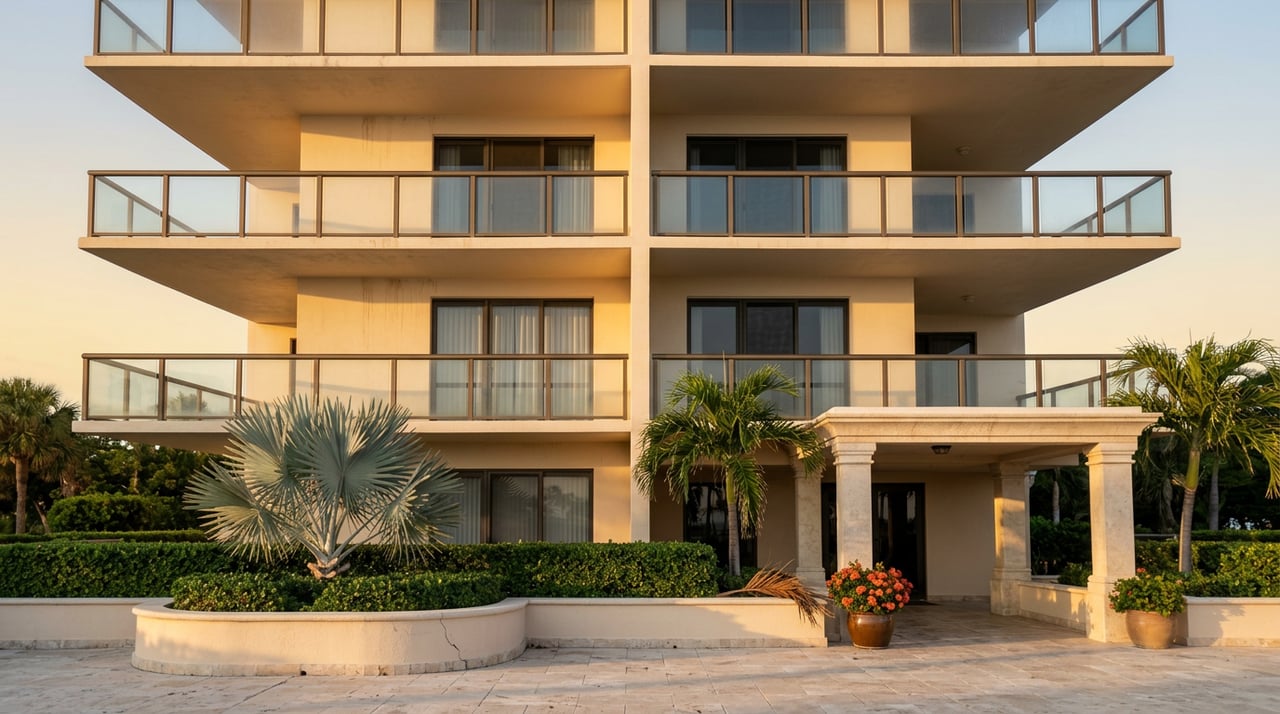
Park Shore's roughly two dozen beachfront high-rises were built in stages as the neighborhood developed from the 1970s through the mid-2000s. A rough sense of the timeline helps frame the conversation:
| Era | Examples | General status |
|---|---|---|
| 1970s | Surfsedge, La Mer | Older stock, typically already through one or more inspection cycles |
| Early-to-mid 1980s | Savoy (1982), Park Shore Tower | Classic full-service towers, often mid-renovation cycle |
| 1990 to 1996 | Vistas, Bay Shore Place, Le Rivage, Le Ciel Venetian Tower, Brittany | Now well past the age where Florida law first triggers scrutiny |
| Early-to-mid 2000s | The Regent (2002), Aria (2006) | Newest towers, further from their first mandatory inspection |
Buyers tend to read this table the way most guides encourage: older equals riskier, newer equals safer. That instinct is not wrong on the engineering side. Concrete does age, and salt air is unkind to rebar. But it misses the part of Florida law that changed everything for every one of these buildings at the exact same moment, regardless of when they were built.
What Actually Changed Wasn't the Building. It Was the Budget.
Florida's post-Surfside reforms created two separate requirements for condo and co-op buildings three or more habitable stories tall: the Milestone Inspection, which examines the structure itself, and the Structural Integrity Reserve Study, or SIRS, which prices out what it will cost to maintain that structure and sets a funding schedule.
For years, boards had an escape hatch. If a budget was adopted on or before December 31, 2024, owners could vote to waive or underfund the reserves an engineer's SIRS said the building needed. That vote was legal, and plenty of associations used it to keep monthly dues lower than the true cost of ownership.
That escape hatch is gone. Under the current rules, any budget adopted on or after January 1, 2025 cannot waive SIRS reserves, and full funding for the eight structural components the law names, including roof, load-bearing structure, plumbing, electrical, and waterproofing, had to begin by January 1, 2026. That timeline applies to a tower built in 1975 exactly the same way it applies to one built in 2006. A 20-year-old building whose board deferred reserves for a decade is walking into 2026 with the same funding cliff as a 50-year-old building that never funded properly either. Age didn't create this moment. The calendar did.
That is the shift most buyers miss. They ask whether a building passed inspection, when the sharper question is whether its board has already absorbed this funding requirement into a real budget, or whether that reckoning is still ahead.
What a Clean File Actually Looks Like
Vistas at Park Shore, a 20-floor tower built in 1990, offers a useful contrast. Its association completed both the state-required Milestone Inspection and the SIRS, and disclosed that no additional special assessment was needed to meet the SIRS funding recommendations, attributing that outcome to disciplined operations and reserve management over time. That is not a guarantee every unit in that building carries zero future cost. It is evidence of what it looks like when a board treats reserve funding as an ongoing responsibility rather than a vote to defer.
Compare that to Park Shore Tower, an 1980s-era building where a recent listing noted all assessments paid following a building-wide renovation that included new paint and electrical work. That phrase, "all assessments paid," is doing real work in that sentence. It means the building has already been through a capital event and the current owner is not carrying that liability forward. It does not mean the next one is priced in yet.
Neither example proves a rule about age. Both prove the same point: the file, not the facade, tells you where the building actually stands.
Naples Has Already Sent the Letters
This is not a hypothetical for Park Shore. The City of Naples applies the coastal 25-year milestone threshold, not the inland 30-year default, to buildings within three miles of the coastline, which covers essentially all of Park Shore's beachfront and bayfront towers. The city's building department has already mailed Notice of Required Milestone Inspection letters, with reports due back to the city in November 2026 based on each notice's mailing date.
That is a live compliance clock running right now, not a future law to watch for. If you are touring a Park Shore high-rise this fall, the building may already be mid-inspection, waiting on engineering results, or newly notified. Each of those states carries a different risk profile for a buyer closing in the next few months.
What to Request Before You Write an Offer
A view and a renovated lobby tell you almost nothing about the numbers behind the wall. Before you make an offer on a Park Shore condo, ask the seller or the association for:
- The most recent Milestone Inspection report, including whether it triggered a Phase 2 structural investigation, since a Phase 2 finding starts a 365-day clock on required repairs.
- The current SIRS, including the funding schedule for the eight mandatory components and whether the board's most recent budget vote occurred before or after January 1, 2025.
- Board meeting minutes covering the last two budget cycles, to see whether reserves were waived, reduced, or funded in full.
- Any pending or approved special assessment notices, along with the building's current reserve balance relative to that schedule.
Lenders are asking harder questions too. Buildings now under milestone or SIRS scrutiny typically require a full underwriting review of the HOA budget, financials, reserve study, delinquency data, and insurance documents before a mortgage closes, which means a thin or outdated file can slow your financing timeline as much as it affects your long-term costs.
This is also where a construction-informed read matters. Reading an engineer's structural findings and translating them into a realistic repair timeline is different from reading a real estate disclosure. Chris Zazo's background in construction and renovation is part of why our team walks these documents with buyers line by line rather than treating a passed inspection as the final word.
What This Means If You're Selling
If you own in one of Park Shore's older towers, the file you can hand a buyer is now part of your asking price, not an afterthought. A completed SIRS with a fully funded schedule and clean minutes showing no waived reserves is a stronger selling point than a fresh coat of paint. Buyers and their lenders are reading these documents more closely than they were two years ago, and a seller who assembles that paperwork before listing controls the conversation instead of reacting to it during a contract period.
A Few Questions Worth Settling Early
Does a passed milestone inspection mean no assessment is coming? No. A milestone inspection evaluates the structure's current condition. The SIRS and the board's funding decisions determine whether the money to maintain that structure has actually been set aside.
Is a 1970s Park Shore tower automatically riskier than a 2000s tower? Not necessarily. Older buildings have often already been through one or more inspection and funding cycles. A newer building whose board deferred reserves under the old waiver rules can face the same funding gap right now that an older, better-managed building resolved years ago.
What's the single most useful document to request? The SIRS funding schedule paired with the last two years of board budget minutes. Together they show not just what the building needs, but whether the association has actually started paying for it.
Park Shore's mix of beachfront towers and bayside mid-rises still offers some of the strongest lifestyle value in Naples, from the walkable promenade along the Gulf to the shops and restaurants at Venetian Village. Getting the building's financial story right just takes a sharper set of questions than the ones most buyers know to ask. If you are weighing a specific tower or comparing a few, our team at Stoots Zazo Luxury Team can help you read the file, not just the listing, before you write an offer.