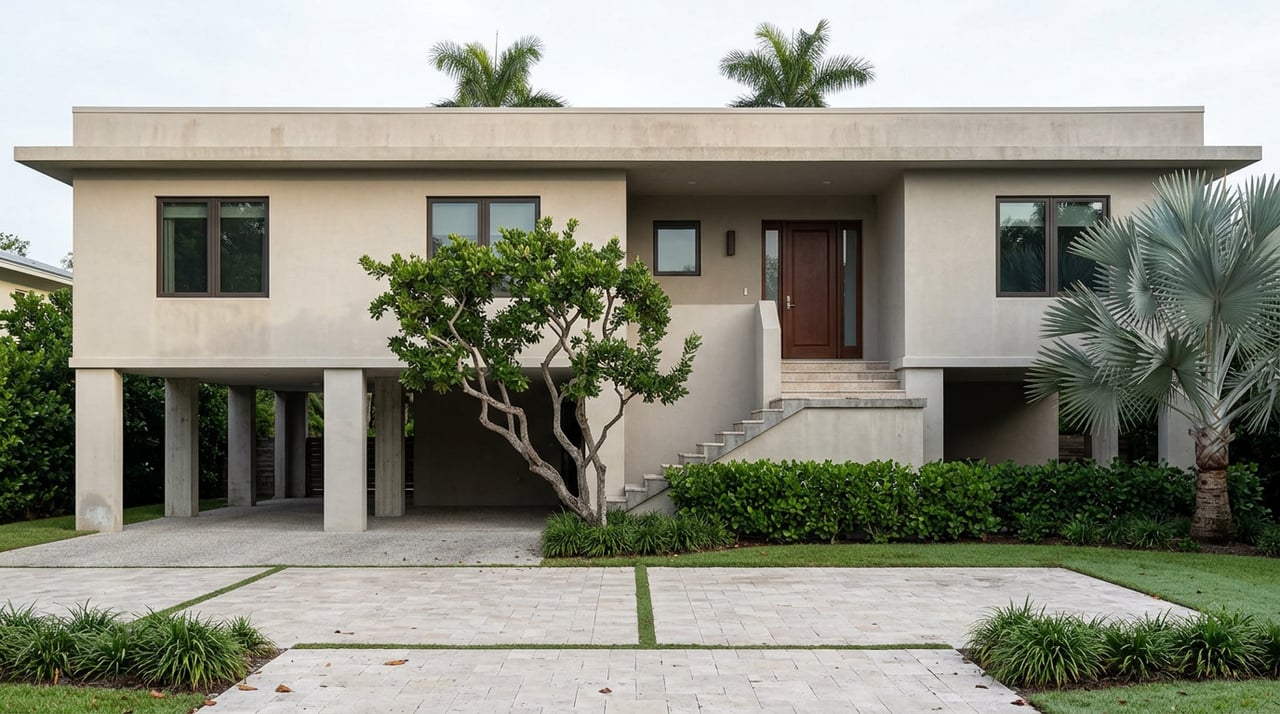
Scroll through listings in Lake Park long enough and a phrase starts repeating itself. A home gets described as "reimagined" or "renovated," and then the details follow: new plumbing, new electrical, new roof, impact windows and doors, new ductwork, all of it built off the original concrete block shell. Not a kitchen refresh. Not new counters and a coat of paint. The whole house, gutted down to its bones and rebuilt from there.
That pattern is not a design trend. It is what happens when a federal flood rule meets a neighborhood full of modest 1960s ranch homes sitting close to the water. Understanding that rule explains something the market data alone cannot: why a "renovated" Lake Park home and a brand-new one often look and cost the same, while a lightly updated one barely exists as a category at all.
The Phrase Every Lake Park Listing Uses
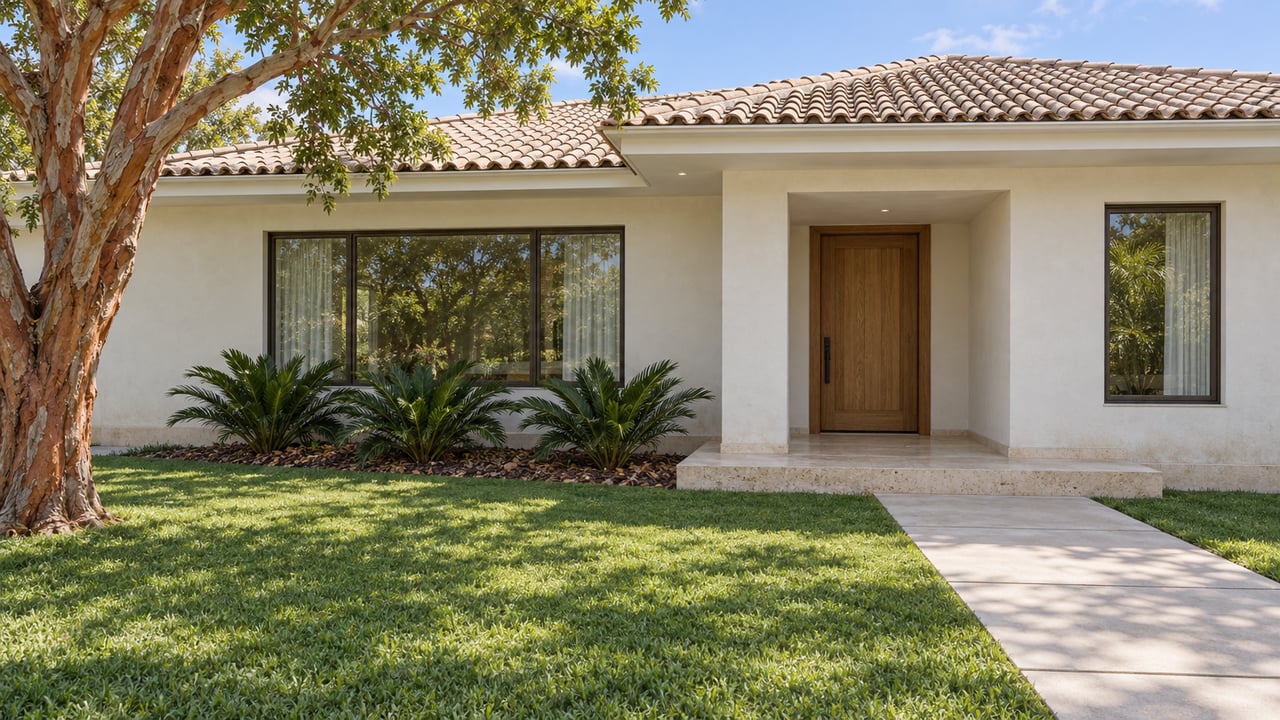
Lake Park was built out mostly in the 1960s, with low, palm-shaded ranch homes on modest lots. Many of those original homes are still standing, and plenty have been remodeled over the decades. But when you read the listing language closely, a genuinely light renovation, new floors, a refreshed bathroom, updated appliances, is a different animal from what gets marketed as a full remodel. The bigger projects tend to describe stripping a home back to its block walls and rebuilding everything above and around them: structural systems, roof, windows, mechanicals, all replaced to current standards.
That is not a stylistic choice by contractors who like starting from scratch. It is usually the cheapest way to comply with a rule that has nothing to do with style at all.
The Rule Hiding Behind the Renovation Photos
The City of Naples, which governs Lake Park, participates in the National Flood Insurance Program and enforces its Substantial Improvement standard, more commonly known as the 50 percent rule. If the cost of a renovation, addition, or repair equals or exceeds 50 percent of a structure's market value before the work begins, the entire building has to be brought up to current floodplain compliance standards. In practice, that usually means elevating the living space to meet or exceed the Base Flood Elevation shown on the city's current flood maps.
The rule counts against the value of the structure only, not the land underneath it. That distinction matters enormously in a neighborhood like Lake Park, where an empty lot can sell for roughly a million dollars on its own. Strip the land value out and what remains, the actual 1960s block structure, often carries a fairly modest market value. It does not take an especially ambitious renovation to spend more than half of that number.
Why the Threshold Bites Harder Here Than Elsewhere in Naples
This is the piece that explains a puzzle we've written about before: in Lake Park, an empty lot and a finished house can carry remarkably similar price tags once land value is factored in. Part of the answer is that there is very little room for a middle path. A homeowner who wants new floors and paint can usually stay under the 50 percent threshold and keep the original elevation. A homeowner who wants a real modernization, opened-up floor plan, new systems, a primary suite addition, is very likely to cross it. Once that happens, the project stops being a renovation in any casual sense and becomes a full compliance rebuild: new footings, an elevated first floor, and a structure that has to meet the same code as new construction next door.
That is why local real estate professionals who work this neighborhood regularly describe just over 500 homes split cleanly into two camps: places that have had light cosmetic work and nothing more, and places that were taken down to the block walls and rebuilt as if new. The in-between renovation, common in flood-zone-free neighborhoods, is less common here because projects that cross the threshold must meet floodplain standards.
How the New State Law Applies in Lake Park
Florida lawmakers spent the spring trying to ease the state's permitting burden. Governor DeSantis signed HB 803 into law on May 6, 2026, and its provisions, including a headline exemption from building permits for single-family work valued under $7,500, took effect on July 1, 2026. For a lot of Florida homeowners, that means smaller cosmetic projects, painting, cabinetry, trim work, no longer require a trip through the permit process.
The exemption comes with a carve-out that matters a great deal here: Pineland Engineering says it does not apply to any property located in a FEMA-designated flood hazard area. Most of Lake Park sits close enough to the lake and its canal system to fall inside that boundary. The City of Naples' own building department has already posted guidance on the new law, and the flood-zone exclusion is spelled out plainly in it. For a homeowner near the water doing a small project, July 1 changed nothing. The permit process, and the 50 percent rule that sits behind it, works exactly as it did before.
What Changes Once a Home Gets Out of the Flood Zone
There is a version of Lake Park where the calculus flips, and it is worth understanding because it shows up in listings too. One home in the neighborhood, originally built in 1954, was completely rebuilt from the ground up in 2012 and updated again in 2025. Along the way, the owners obtained a Letter of Map Amendment from FEMA, documenting an elevation of 11.2 feet, high enough to remove the property from the Special Flood Hazard Area entirely.
That is the other side of the ledger. That mapped status creates a meaningfully different ownership position, and it is one buyers should specifically look for when comparing two homes that otherwise appear similar on paper.
Naples architecture firm Hlevel Architecture took the elevation question head-on in a Lake Park project for a retired couple, designing the living space above flood level while adding age-in-place features and hurricane-resistant construction. It is a useful example of how a thoughtful renovation in this neighborhood treats elevation as a design starting point rather than an afterthought.
What to Ask Before You Write an Offer (or List)
If you're evaluating an older Lake Park home, a few questions do more work than a general walk-through:
- Has the city's Floodplain Coordinator confirmed the property's current flood zone designation and Base Flood Elevation? The office can be reached directly at 239-213-5008 or by email at [email protected], and existing elevation certificates on file are worth requesting before you get attached to a floor plan.
- What was the total cost of any prior renovation work, and does the permit history show it was reviewed against the 50 percent threshold?
- Has the structure ever received a Letter of Map Amendment or similar determination taking it out of the Special Flood Hazard Area?
For sellers, the same questions shape how a property should be positioned. A home that has never crossed the 50 percent threshold is honestly a renovation candidate, not a finished product, and pricing it as though it competes with a full rebuild sets up a disappointing appraisal. Our team's background includes hands-on construction and renovation work, which is part of why we walk clients through this math before it becomes a surprise mid-contract.
A Few Questions Worth Settling Early
Can I do a renovation in phases to stay under the 50 percent threshold each time? Confirm the city's current approach with the Floodplain Coordinator before assuming a phased plan will work.
Does the 50 percent rule apply to the land value too? No. It is calculated against the market value of the structure alone, which is exactly why lot value and structure value need to be considered separately when you're pricing a renovation project in this neighborhood.
If a home already has a Letter of Map Amendment, is it flood-insurance-free forever? A LOMA reflects current elevation and mapping at the time it was issued. Flood maps do get updated, so it's worth confirming the determination is still current before assuming it carries forward indefinitely.
If you're weighing a Lake Park property, whether it's a renovation project, a potential teardown, or a home that's already been elevated and mapped out of the flood zone, Stoots Zazo Luxury Team can walk through the construction and compliance side alongside the real estate side before you make an offer. Contact us to talk through a specific address.
This article is general information, not legal, tax or financial advice. Consult a qualified professional about your situation.